
Active Recall
If you are completely new to study methods, active recall is one of the best places to start. It sounds academic, but the idea is actually very simple: stop only looking at the information, and start trying to pull it back out of your own mind. That tiny shift changes studying from passive exposure into real memory training.
What active recall actually means
Most students think studying means reading, highlighting, or going over notes again and again. That feels productive because your eyes are moving and the page looks familiar. The problem is that familiarity is not the same thing as memory. A page can look recognizable while your brain still cannot produce the answer when the notes are gone.
Active recall means you deliberately make memory do the work. Instead of staring at the answer, you pause and ask, “Can I explain this without looking?” That is the whole method. You try to bring the idea back from your own head first. If you can, the memory gets stronger. If you cannot, you discover the gap early instead of discovering it in the exam.
That is why active recall feels harder than rereading. It is harder because it is doing something real. It is not just showing you the material again. It is teaching your brain how to retrieve it.
See active recall in action
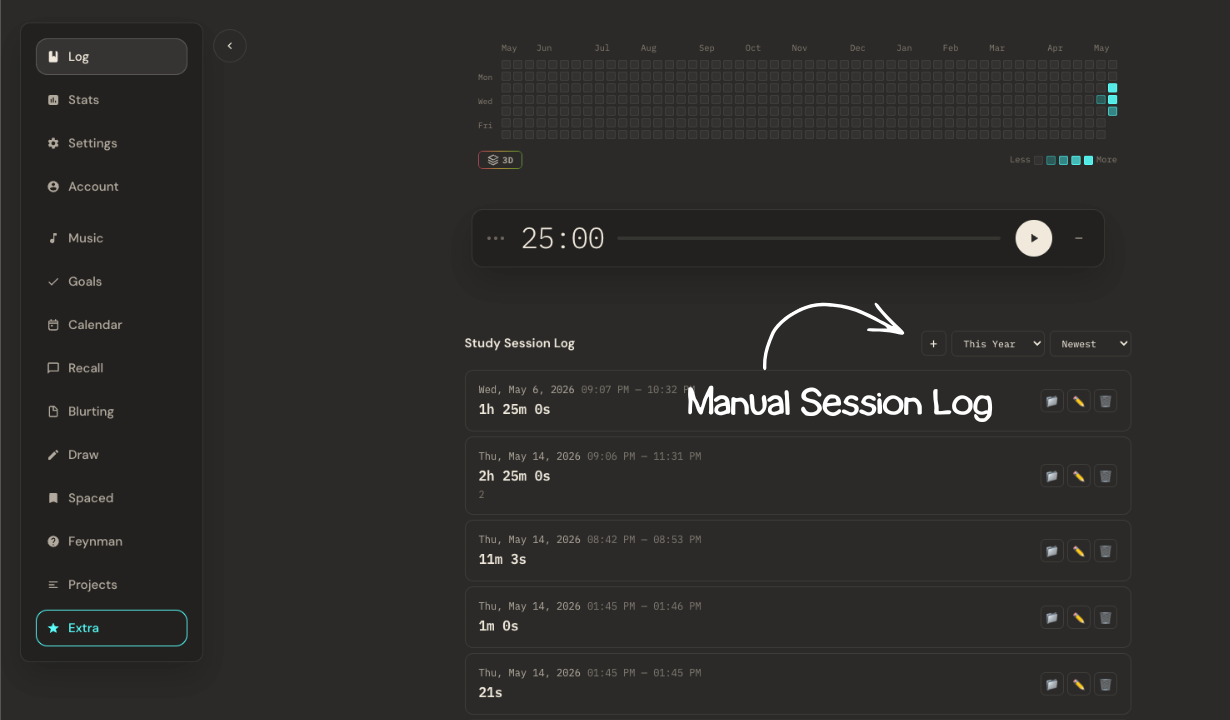
This walkthrough makes the method feel less abstract. Instead of reading about memory in theory, you can see how active recall turns a study session into repeated attempts to bring the answer back without leaning on the page every few seconds.
That is the real shift: you stop asking whether the notes look familiar and start asking whether your brain can produce the idea on its own. That is what makes the method powerful for beginners and experienced students alike.
Think of it like mental lifting
Reading the answer over and over is a bit like watching someone else do the workout. You may understand what is happening, but your own memory is not getting much stronger. Active recall is the moment you do the lift yourself. You try, you struggle a little, and that struggle is exactly what builds the skill.
This matters because exams rarely ask, “Does this paragraph look familiar?” They ask, “Can you bring this back right now, under pressure, with no page in front of you?” Active recall trains for that exact moment.
Why active recall works better than passive studying
Passive studying can trick you. You reread the same chapter, and by the third pass everything feels smooth. You think, “I know this.” Then you close the book and suddenly the idea becomes vague. That happens because recognition is easier than retrieval. Seeing the answer is not the same as producing the answer.
Active recall breaks that illusion. It gives you a more honest picture of what is actually in memory. If you can explain a concept, define a term, solve the next step of a problem, or answer a question without looking, that knowledge is becoming usable. If you cannot, that is not failure. It is useful information. It tells you exactly where to review.
- It shows you what you really know, not just what looks familiar.
- It strengthens retrieval, which is the part exams and real problem solving depend on.
- It makes review more efficient because weak areas become obvious faster.
- It creates more confidence over time because recall becomes less fragile.
How to use active recall if you are a complete beginner
The easiest way to begin is small. Read one short section of your notes or textbook. Then close it. Now ask yourself, “What were the main points?” Try to say them out loud or write them down from memory. Do not worry if it feels messy. That awkwardness is normal. You are building the habit of retrieval.
After you try, reopen the notes and compare. You will usually notice three things: what you remembered well, what you half remembered, and what disappeared completely. That is the gold. Now your brain knows what deserves another pass, and your next few minutes become much more focused.
Use questions
Turn headings into questions. If the heading says “Causes of inflation,” ask yourself, “What are the causes of inflation?” then answer without looking.
Explain aloud
Pretend you are teaching someone with zero background. If you can explain it simply, your understanding is probably getting stronger.
Write from memory
After reading, close the material and list definitions, steps, formulas, or arguments from memory before checking.
Repeat in rounds
Do not expect perfect recall on the first try. Active recall works because you repeat the retrieval cycle, not because you nail it instantly.
What active recall looks like in real subjects
In history, active recall might mean closing the notes and rebuilding the causes of an event in order. In biology, it might mean drawing a process from memory and then checking what you missed. In math, it might mean looking at a solved example, covering it, and trying the method yourself without the steps in front of you. In language learning, it could mean recalling a word, tense, or grammar rule before peeking.
The exact format changes, but the principle stays the same: do not just consume the material again. Force yourself to produce something from memory. That production can be spoken, written, drawn, solved, or explained. The method is flexible. The important part is that your brain has to reach for the knowledge instead of being fed the answer.
Common mistakes students make with active recall
The first mistake is turning it into perfectionism. Active recall is not about proving you are brilliant. It is about finding the weak spots while there is still time to fix them. Struggling does not mean the method is failing. Struggling is often the method working.
The second mistake is making the questions too big. If you ask yourself to remember an entire chapter at once, the method can feel discouraging. Break it down. Recall one definition, one mechanism, one paragraph, one concept map. Small wins scale better.
The third mistake is using active recall once and then going back to passive reading forever. It works best when it becomes a routine. That is also why it pairs so well with spaced repetition: active recall tells you how to practice, and spaced repetition helps you decide when to come back.
Why active recall and spaced repetition work so well together
If active recall is the act of pulling knowledge out of memory, spaced repetition is the timing system that tells you when to do it again. One improves the quality of practice. The other improves the timing of practice. Together, they form one of the strongest study systems a beginner can build.
A simple rhythm looks like this: learn something new, test yourself on it, check the gaps, then return later and test yourself again. That repeated retrieval over time is what turns “I sort of know this” into “I can bring this back when it counts.”
What students usually notice after using it for a while
At first, active recall feels slower because it forces honesty. But after a while, many students notice the opposite: revision gets cleaner. They waste less time circling the same pages. They become less dependent on highlights. They start noticing what they actually know, which makes the next study block easier to plan.
The biggest shift is confidence. Not fake confidence from seeing the page again, but real confidence from being able to answer without it. That is what makes active recall so good for exams, oral answers, timed conditions, and long-term learning in general.